

Top AI Browser Automation Tools for 2026
Browser automation used to be simple: pick a tool, write scripts, run them. That world is gone. Modern automation is no longer about running scripts. It’s about orchestrating AI agents, cloud browsers, and infrastructure together to execute complex workflows reliably.
Instead of choosing a single automation tool, you’re designing an entire automation architecture. AI agents reason about tasks, cloud browsers handle execution, and the surrounding infrastructure determines scalability and reliability.
This guide breaks down the best AI browser automation tools available today and explains where each one fits in the modern automation stack.
TL;DR
- There is no single “best tool”.
- Automation now requires agents + execution + infrastructure.
- Most tools cover only one layer.
- Production systems need all three.
The New Stack: Three Layers of Browser Automation
To build reliable systems, you need to understand the three distinct layers of modern automation.
1. Agent Layer (Reasoning)
Powered by large language models (LLMs), this layer decides what actions to take. It interprets the page state and determines the next action.
2. Execution Layer (Browser)
This layer runs the workflows. It interacts directly with the user interface, clicking buttons and typing text.
3. Infrastructure Layer (Scaling)
This is the foundation. It handles concurrency, state isolation, secure credential management, retries, and observability.
Most tools only focus on one layer. This explains why AI automation tools often work flawlessly in a local demo but break down in production environments.
Categories of Browser Automation Tools
Instead of reviewing tools as a flat list, it’s more useful to group them by their primary role in the automation stack.
- AI Agent Frameworks: Driven by large language models (LLMs), these tools reason about workflows and decide what actions to take. They offer high flexibility but can sometimes be unpredictable in production environments.
- Automation Frameworks: Deterministic automation tools such as Playwright and Puppeteer. They provide precise control and high reliability, but require manual coding and engineering effort.
- Cloud Browser Infrastructure: These platforms provide scalable browser environments for running automation workflows. They handle concurrency, session management, and distributed execution—solving many production-scale challenges.
- No-Code Tools: Designed for simple workflows and non-technical users. While easy to use, they often lack the flexibility required for complex automation or engineering use cases.
AI + RPA Enterprise Automation Tools
AI-driven robotic process automation (RPA) and enterprise automation platforms combine AI capabilities with robust workflow management. These tools are designed for large organizations that require end-to-end automation across complex business processes.
UiPath AI Agents: Bring AI reasoning and document understanding to enterprise automation, integrating with legacy systems and cloud applications. Automation Anywhere: Offers AI-powered bots for automating complex business workflows, with scalability, analytics, and secure execution.
These solutions excel in environments where reliability, auditing, and integration with enterprise IT infrastructure are crucial. They bridge the gap between browser-centric automation and broader business operations, making them ideal for companies with compliance or large-scale process needs.
Best AI Browser Automation Tools (2026)
AI Agent Frameworks
- Browser Use
Browser Use is an open-source agent framework. It lets you tell your computer what to do using natural language. It works great for prototyping and experimentation. However, it requires a robust infrastructure layer to scale reliably.
- Stagehand (Browserbase)
Built by Browserbase, Stagehand offers natural language automation combined with self-healing features. It acts as an open-source alternative to Playwright. It bridges the gap between agents and execution, though it remains early for complex enterprise workflows.
- Firecrawl
Firecrawl is a web data API for AI. It excels at turning entire websites into clean, LLM-ready markdown or structured data. It handles scraping beautifully, but it is less suited for deep operational automation.
Automation Frameworks
- Playwright
Playwright is the most reliable deterministic framework available. It features built-in auto-waiting and tracing. It serves as an excellent execution engine, but it is not enough on its own for scaling out hundreds of concurrent sessions.
- Puppeteer
Puppeteer is lightweight, fast, and optimized for Chrome. It handles simple flows well. It falls short compared to Playwright for robust production systems.
- Selenium
Selenium is the legacy standard for enterprise testing. It remains widely used across the industry. Yet, it lacks the optimization needed for modern, AI-driven workflows.
Cloud Browser Infrastructure
- Browserbase
Browserbase offers managed browser infrastructure. It provides server caching, session replay, and prompt observability. It solves execution at scale, filling a critical missing layer for developers.
- Bright Data
Bright Data focuses heavily on proxy networks and anti-bot mechanisms. It provides fully managed cloud browsers designed to bypass CAPTCHAs. This makes it crucial for scraping-heavy workflows.
Anchor Browser Anchor delivers deterministic cloud browser infrastructure designed specifically for AI agents and production automation. Built for reliability, observability, and scale, Anchor lets you spin up thousands of parallel instances. It handles bot detection, session management, and secure execution environments, and integrates seamlessly with SSO and VPNs. Breaks at scale without infrastructure (no isolation, retries, or concurrency control).
Where most tools stop at simple execution, Anchor focuses on execution reliability and state isolation. This is the layer that turns a fragile local script into a secure, enterprise-grade system.
No-Code / Workflow Tools
- Bardeen
Bardeen automates browser apps with an AI copilot. It is great for simple tasks and business users looking to save time. It lacks the deep scalability required for engineering systems.
- Axiom / Browserflow
These are visual Chrome extension automation tools. You can build bots quickly without writing code. They are incredibly fast to start but very hard to scale across a large organization.
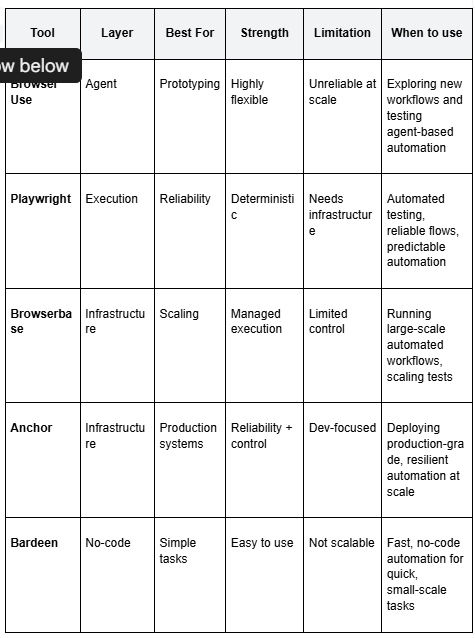
Tool Comparison at a Glance##
What Most “Best Tools” Lists Miss About Automation
Many comparisons assume the tool itself is the complete solution. In reality, the biggest failures in browser automation come from missing infrastructure.
Without the right infrastructure foundation, teams often struggle with:
- No state isolation between test runs
- Poor retry controls when a page fails to load
- Zero observability when an automation breaks
- Broken concurrency management under heavy load
This is why automation workflows often pass on a local machine but fail when deployed in cloud environments.
How to Choose the Right Automation Stack
Building the right automation architecture depends on your specific goals and use case.
- If you are experimenting: Start with AI agent frameworks to test feasibility.
- If you need high reliability: Stick to Playwright and structured workflows.
- If you are scaling: Add a cloud browser infrastructure layer to manage the load.
- If you are building AI agents: Use a hybrid approach that combines an agent, deterministic execution, and strong cloud infrastructure.
Recommended Automation Architectures
Simple automation
Use Playwright on its own for basic browser testing and data extraction.
Mid-scale workflows
Combine Playwright with queue management and retry logic to handle transient failures and workflow interruptions.
AI agent workflows
Pair an agent framework with Playwright and a basic infrastructure layer to keep the LLM on track.
Enterprise scale
Deploy an agent framework alongside deterministic execution and cloud browser infrastructure like Anchor. This guarantees security, speed, and reliability.
The Future of AI Browser Automation
The browser automation ecosystem is rapidly converging. Soon, the boundaries between agents (reasoning), browsers (execution), and infrastructure (scaling) will blur.
Most tools today focus on only one layer of the automation stack. The platforms that succeed will combine all three to deliver seamless and reliable automation.
Take the Next Step in Your Automation Stack
There is no single best tool for every use case. There is only the architecture that best fits your needs.
AI agents are incredibly powerful, but they are not sufficient on their own. Deterministic execution remains critical for predictable results. Infrastructure is the missing layer that holds it all together. Production automation requires all three layers working in sync.
If you’re already hitting reliability or scaling issues, it’s likely not a tooling problem, it’s an infrastructure gap.
Evaluate your current automation stack. Identify the missing layer, and start building automation systems you can trust.

