Sail is building the intelligence layer for consumer-directed healthcare. Its API tells platforms what’s actually in a purchase, whether it’s HSA or FSA eligible, and what’s sitting in a user’s health accounts. To get that data, Sail has to log into portals that don’t want to be automated, usually while the user is watching. And someone waiting on a login screen gives you about 30 to 40 seconds before they give up.
That window is why Sail runs its browser automation on Anchor Browser. Sail now logs users into portals in about 38 seconds end to end, down from 60+ seconds on its earlier agentic stack, and has 14 portals in production. Sail keeps control of its own flows with Playwright, while Anchor handles anti-bot, proxies, and browser reliability.
We sat down with Jonah Jolley, Sail’s VP of Engineering, to hear how they got there.
Two jobs for a browser: HSA connectivity and item-level data
Sail needs a browser for two things that card feeds and open banking don’t cover well.
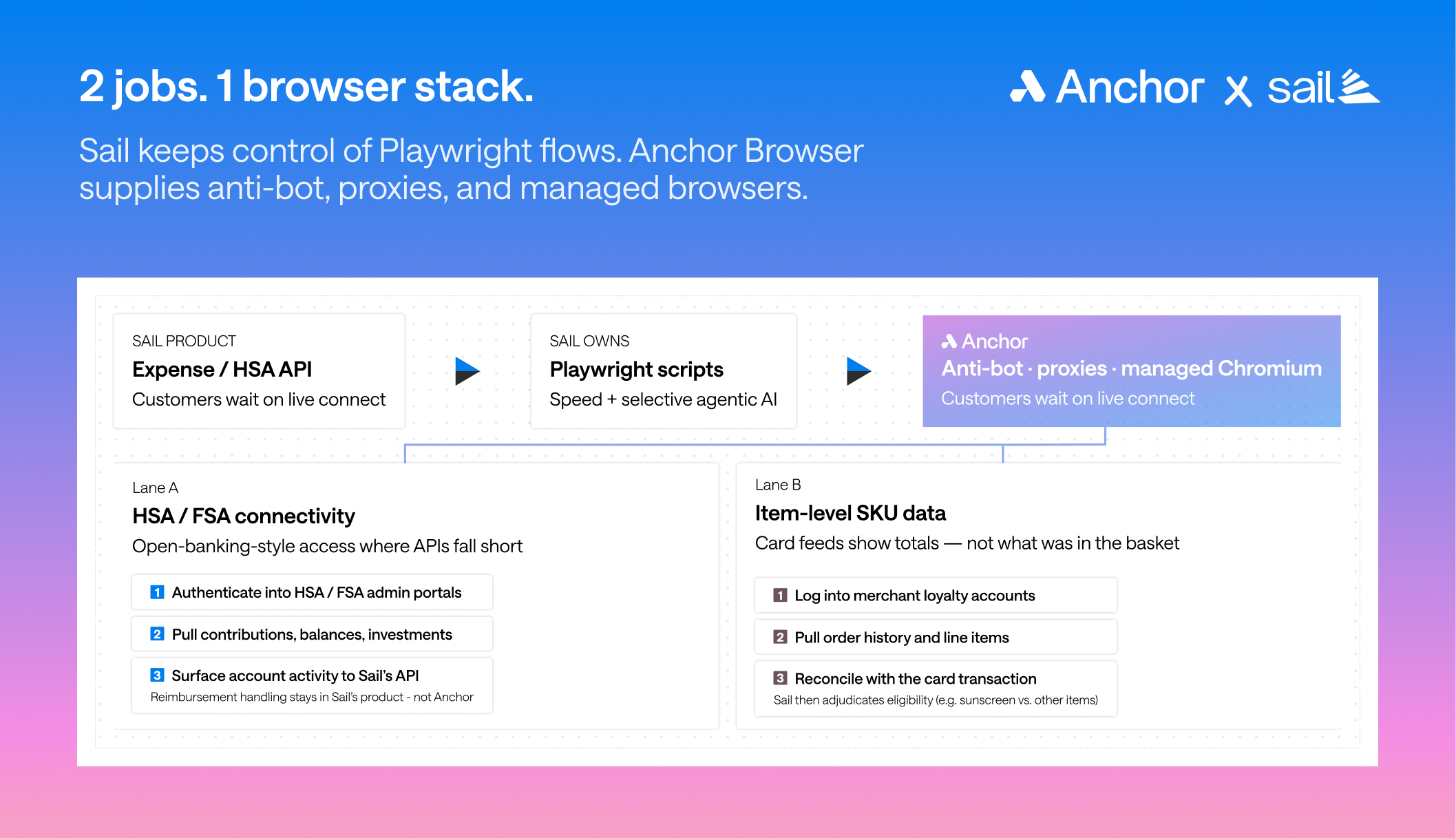
The first is HSA and FSA connectivity: contributions, balances, investment activity, and reimbursements, pulled from the accounts where they live. Think of it as open banking for HSA administration.
The second is item-level SKU data. A card feed shows a transaction total, not what was in the basket. So Sail logs into loyalty and merchant accounts, pulls order history, reconciles each order against the card transaction, and surfaces what is eligible. One charge can turn out to be a sunscreen and an SPF lip balm, each with its own eligibility answer. Sail’s customers are often personal finance managers and similar platforms that want that level of detail.
From a CDP vendor to agents to Playwright
Sail’s path to Anchor ran through two other setups. It started on a CDP-based browser infrastructure vendor that handled some anti-bot but could not cover all the sources Sail needed.
Then came roughly ten months on a more agentic browser stack. The agents were strong, but every state change added something like 3 to 4 seconds while the model re-oriented itself. Across a multi-step login, that adds up. And Sail’s logins happen while the user is watching.
“We need to log somebody into a browser while they’re there, and if it’s more than 30 to 40 seconds, somebody’s going to churn.”
— Jonah Jolley, VP of Engineering, Sail
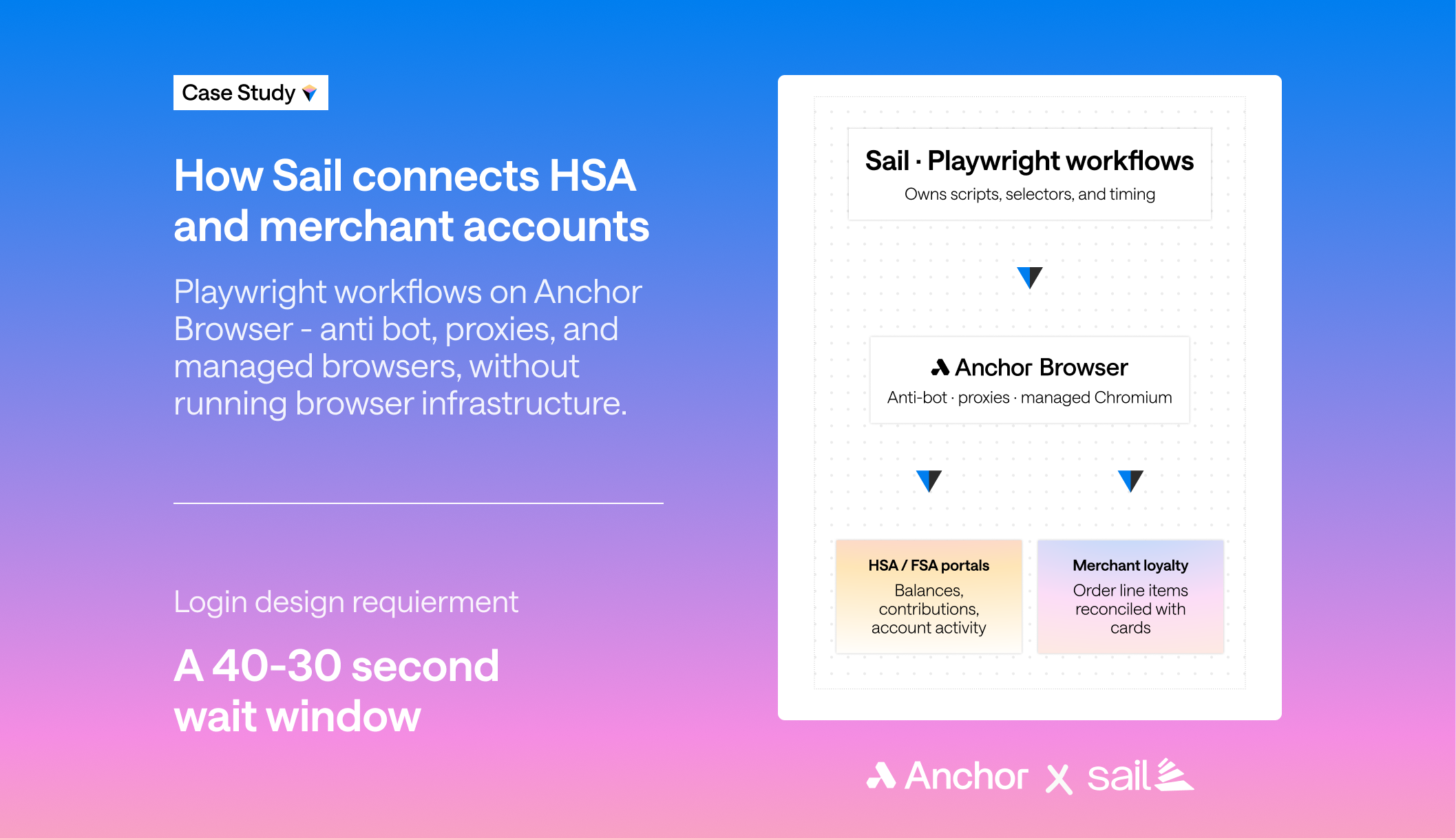
So Sail pulled control back in-house with Playwright and put the hard parts on Anchor: anti-bot, proxies, and browser reliability, with no proxy layer for Sail to run itself. Owning the flows had a second benefit. Sail now chooses when to use agentic AI in a flow, for speed and reliability, instead of on every step.
Why Anchor won the POC
The bar for the proof of concept was clear: anti-bot that works on Sail’s actual sources, speed (which is tied to proxies), and a clean developer path for driving Playwright.
The partnership mattered as much as the tech. With Anchor, hard sources get worked on together rather than met with “sorry, we don’t support that.”
“Where it wasn’t [perfect], the Anchor team has been so on top of it… We’re working through these problems together.”
— Jonah Jolley, Sail
As Jonah sees it, it’s been a partnership where both products get better.
The result: 38-second logins and demos that land
A typical end-to-end login through Anchor now takes about 38 seconds, compared with 60+ seconds on Sail’s earlier agentic stack. Sail is still ramping, but runs are consistently successful, and 14 portals are now in production, up from 5 in just two weeks. Sail is looking to triple the number of portals by the end of the year.
The gnarliest unlock was not one portal. It was getting login and interaction close enough to a real user’s pace that live demos land.
“We’re able to log in users and interact with browsers… so close to a user just interacting themselves that it feels so fast for them. And because of that speed we’ve been able to really impress a lot of people in our demos.”
— Jonah Jolley, Sail
Fixed before the deal even closed
During diligence, Sail accidentally pointed traffic at a portal outside the scope of the POC, a major pharmacy. Before anyone on Sail’s side noticed, Dor, Anchor’s co-founder and CTO, pinged them on Slack: he had seen the run fail, fixed it, and told them to try again.
“Even before getting the deal… watching and obsessing over all of our tests… That was incredible.”
— Jonah Jolley, Sail
What’s next
Sail is at 14 portals today and racing to add more, with dozens of merchant accounts that carry order detail still to come. As Anchor continues to support Sail, we continue to see new use cases emerge that until now had been believed impossible to do. Each unlock moves companies to an agentic future.
How can you get this performance from your browser agents?
Anchor embeds with customers to get maximum value with minimal effort for your team. If you’re wrangling a login page, been blocked from too many websites, or generally want to re-vamp your infrastructure for agents, reach out here to the Anchor team.