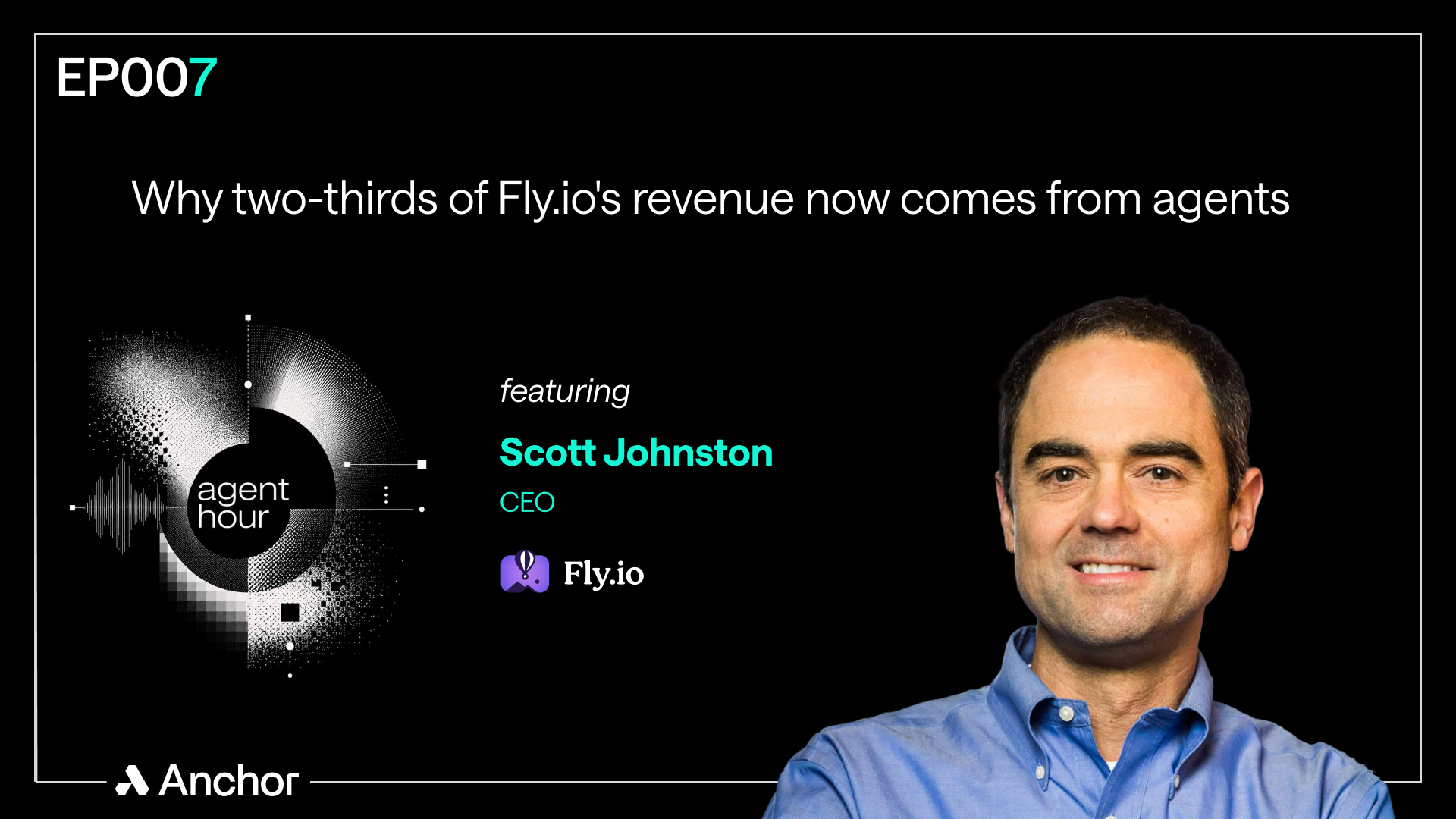
Exploring the unique infrastructure needs for agents in today's tech landscape.
In the latest episode of Agent Hour, Gabi Weinberg sits down with Scott Johnston, the new CEO of Fly.io, to delve into the evolving landscape of infrastructure for agents and the exciting challenges it presents.
A Shifting Landscape
Scott reflects on his journey through pivotal moments in tech, from the early days of Netscape to his time at Docker. He emphasizes that we are witnessing a tectonic shift in the industry, similar to past revolutions, driven largely by the rise of agents. With agents now taking on a central role in development, Scott shares insights on how this impacts infrastructure needs.
"These moments where the industry shifts so dramatically don’t come by every year. They come every eight to ten years or so where just all these forces build up such that the stacks have to be completely redone."
The Unique Needs of Agents
As Gabi and Scott discuss the specific requirements that agents have compared to traditional applications, Scott identifies several key differences:
- Statefulness: Unlike traditional stateless applications, agents require environments that can adapt to changing data and conditions in real-time. This necessitates a fundamentally different approach to compute resources.
- Complexity Handling: Agents can manage greater complexity compared to human developers. Their ability to operate with lower-level commands allows for more nuanced and flexible applications.
Scott points out that the development landscape is shifting, where agents are now the new interface for developers.
Unlocking Potential for Agents
Scott outlines the top challenges and bottlenecks for agents, including the need for integrated statefulness and efficient isolation for security. He highlights Fly.io's achievements, such as their best-in-class checkpoint and restore capabilities, which allow agents to operate seamlessly without compromising efficiency or security.
The New Customer Paradigm
The conversation wraps up with a look at Fly.io's evolving customer base. With agent-driven customers now accounting for a significant portion of their revenue, Scott explains the changes in their go-to-market strategy, including packaging and pricing adjustments tailored for this new audience.
In this agent-centric world, the traditional development model is giving way to a more dynamic, agent-driven approach. As Scott aptly puts it,
"The discovery process is still very much bottoms up, but instead of developers only, it's developers along with their agent discovering us."
Reflecting on this exciting moment in infrastructure technology, Scott and Gabi's discussion opens up new perspectives on the future of development and the role of agents.
Listen to the Full Episode
For more insights from this conversation and to explore the full episode here or on a platform of your choice: